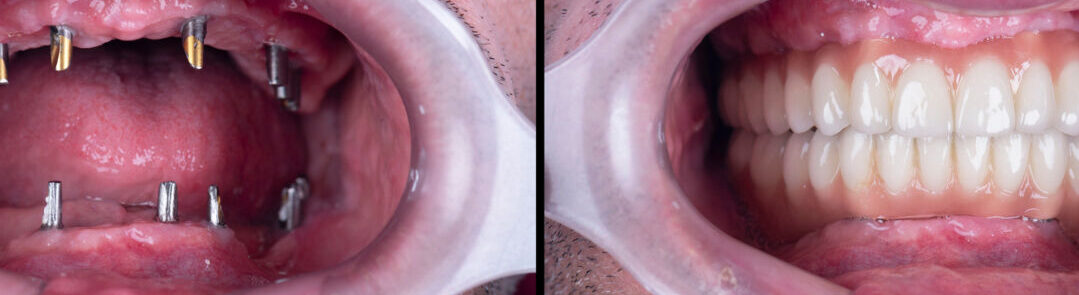
What is Basal Dental Implant?
A Basal Dental Implant is an advanced type of dental implant treatment used to replace missing teeth or support a full mouth fixed denture. Unlike conventional dental implants that are placed in the upper soft bone of the jaw, basal implants are anchored into the basal cortical bone, which is the strongest and hardest part of the jawbone. This bone remains stable for a lifetime and is less likely to shrink even after tooth loss.
Basal implants are also called:
- Cortical implants
- Bicortical implants
- Immediate loading implants
This treatment is mainly used for:
- Full mouth rehabilitation
- Patients with severe bone loss
- Patients who do not want bone grafting
- People who want fixed teeth in a very short time
In conventional implants, many patients require bone grafting or sinus lift surgery because the upper jawbone becomes weak after tooth loss. However, basal implants are designed to use the deeper and stronger bone, so additional surgeries are usually not needed.
Basal implants have become very popular because they provide fast, fixed, and long-lasting teeth with minimal surgery.
How Does Basal Implant Work?
In this procedure, the implant is inserted into the cortical or basal bone using a special technique. The cortical bone is very dense and highly resistant to infection. Because of this strong anchorage, the implant becomes stable immediately after placement.
After implant placement, a fixed bridge or denture can often be attached within a few days. This is called immediate loading.
The treatment usually includes:
- Dental examination and X-rays/CBCT scan
- Removal of damaged teeth if required
- Placement of basal implants
- Trial of fixed teeth
- Final fixed bridge placement
Timing to Fix Full Denture in Basal Implant
One of the biggest advantages of basal implants is the speed of treatment.
In Most Cases:
The full fixed denture is attached within:
- 72 hours (3 days)
OR - 3 to 5 days
This is much faster than conventional implants.
Conventional Implant Timing
Traditional implants generally require:
- 3 to 6 months healing time
- Bone graft healing
- Multiple surgeries
- Temporary removable dentures during healing
Basal Implant Timing
With basal implants:
- Implants are fixed immediately into strong cortical bone
- Healing time is minimal
- Fixed teeth are given quickly
- Patient can eat and smile faster
Why Immediate Loading is Possible?
The cortical bone is:
- Very dense
- Highly mineralized
- Strong enough to hold implants immediately
Therefore, the implants achieve excellent primary stability, allowing the dentist to fix the denture rapidly.
Why BP and Sugar Are Often Less Important in Basal Implant?
Many clinics mention that BP (blood pressure) and sugar (diabetes) are “not important” in basal implants. Medically, this statement should be understood carefully.
Important Clarification
Patients with diabetes or BP problems still require proper medical evaluation. However, basal implants are considered safer and more successful in many medically compromised patients compared to conventional implants.
Why Basal Implants Work Better in Diabetic Patients
1. Less Invasive Procedure
Basal implant surgery is usually:
- Flapless or minimally invasive
- Faster procedure
- Less bleeding
- Less trauma to tissues
This reduces healing complications.
2. No Bone Grafting Needed
Conventional implants often require:
- Bone grafting
- Sinus lift surgery
- Multiple surgeries
Diabetic patients may heal slowly after these procedures.
Basal implants avoid these extra surgeries, reducing risk.
3. Cortical Bone Has Better Stability
Basal implants engage dense cortical bone which:
- Has better blood supply stability
- Is less affected by bone loss
- Provides strong anchorage
This improves implant success.
4. Immediate Function Helps Bone
When implants are loaded quickly:
- Bone receives functional stimulation
- Bone remodeling improves
- Stability increases over time
5. Reduced Infection Risk
Because basal implants:
- Use polished implant surfaces
- Are less invasive
- Avoid grafting materials
The risk of infection may be lower.
Important Note About Sugar Patients
Even though basal implants are more suitable for diabetic patients:
- Extremely uncontrolled diabetes is still risky
- Sugar levels should ideally be controlled
- Dentist and physician approval may be required
A well-controlled diabetic patient is usually considered a good candidate for basal implants.
Important Note About BP Patients
Patients with high blood pressure can also undergo basal implant treatment if:
- BP is under medical control
- Medications are continued properly
- Stress and anxiety are managed during treatment
Basal implant surgery is usually shorter and less traumatic, which is beneficial for BP patients.
Benefits of Basal Dental Implant
Basal implants provide many advantages over traditional implants.
1. Immediate Fixed Teeth
One of the biggest benefits is rapid treatment.
Patients can often receive:
- Fixed teeth in 3 to 5 days
- Immediate smile restoration
- Quick chewing ability
This improves confidence instantly.
2. No Bone Grafting Required
Even patients with severe bone loss can often receive basal implants without:
- Bone grafting
- Sinus lift surgery
- Major augmentation procedures
This saves:
- Time
- Money
- Pain
- Surgical risk
3. Suitable for Severe Bone Loss
Many patients are rejected for conventional implants because of insufficient bone.
Basal implants are ideal for:
- Atrophied jaws
- Old denture users
- Long-term missing teeth cases
Because they use deep cortical bone.
4. Faster Healing
Healing is usually quicker because:
- Surgery is minimally invasive
- Tissue trauma is less
- Blood supply remains better
Patients experience:
- Less swelling
- Less pain
- Faster recovery
5. Immediate Chewing Function
Patients can start eating soft food quickly after treatment.
Benefits include:
- Better nutrition
- Improved comfort
- Faster adaptation
6. Fixed Teeth Instead of Removable Dentures
Basal implants support fixed prosthesis, meaning:
- Teeth do not move
- No denture slipping
- Better speech
- Better confidence
Patients feel like they have natural teeth again.
7. Better Smile and Facial Appearance
Missing teeth can cause:
- Sunken cheeks
- Aged appearance
- Facial collapse
Basal implants restore:
- Facial support
- Smile aesthetics
- Lip support
- Younger appearance
8. Long-Term Stability
Cortical bone remains stable for years.
This provides:
- Strong implant support
- Long-term durability
- Reduced bone shrinkage
9. Less Surgical Trauma
Basal implant surgery generally involves:
- Smaller incisions
- Less cutting
- Minimal stitches
Therefore:
- Recovery is easier
- Complications are reduced
10. Useful for Smokers
Smoking negatively affects traditional implants due to poor healing in softer bone.
Basal implants may perform better because:
- Cortical bone has stronger anchorage
- Immediate loading helps stability
- Polished surfaces reduce infection risk
However, smoking reduction is still recommended.
11. Reduced Treatment Time
Traditional implant treatment may take:
- 6 months to 1 year
Basal implant treatment often completes within:
- Few days
This is very convenient for working people and elderly patients.
12. Cost Effective in Many Cases
Although basal implants may initially appear expensive, they often reduce the need for:
- Bone grafting
- Multiple surgeries
- Long treatment visits
This can lower total treatment expenses.
13. Better Psychological Confidence
Patients suffering from missing teeth often face:
- Social embarrassment
- Low confidence
- Difficulty speaking
Fixed basal implant teeth help patients:
- Smile confidently
- Speak properly
- Improve self-esteem
14. Better Speech
Loose dentures may affect pronunciation.
Fixed teeth improve:
- Clarity of speech
- Comfort during talking
- Confidence in public speaking
15. Strong Bite Force
Basal implants provide excellent support for chewing.
Patients can often enjoy:
- Harder foods
- Better chewing efficiency
- Improved digestion
Who is a Good Candidate for Basal Implant?
Basal implants are suitable for:
- Full mouth missing teeth
- Severe bone loss patients
- Diabetic patients (controlled)
- Smokers
- Elderly patients
- Failed conventional implant cases
- Patients wanting immediate teeth
Difference Between Basal Implant and Conventional Implant
| Feature | Basal Implant | Conventional Implant |
|---|---|---|
| Bone Used | Cortical/Basal bone | Alveolar bone |
| Loading Time | Immediate | Delayed |
| Denture Fixing | 3–5 days | 3–6 months |
| Bone Grafting | Usually not needed | Often needed |
| Surgery | Minimally invasive | More invasive |
| Suitable for Bone Loss | Yes | Sometimes difficult |
| Healing Time | Faster | Longer |
| Treatment Duration | Few days | Several months |
Care After Basal Implant Treatment
To maintain implant success:
- Brush regularly
- Maintain oral hygiene
- Avoid tobacco if possible
- Attend follow-up visits
- Follow dentist instructions
- Eat soft food initially
Proper care increases long-term success.
Conclusion
Basal dental implants are a modern and highly effective solution for replacing missing teeth, especially in full mouth rehabilitation cases. Unlike conventional implants, basal implants use the strong cortical bone of the jaw, allowing immediate stability and fast treatment.
One of the biggest advantages of basal implants is that fixed teeth can usually be provided within 3 to 5 days. The treatment is less invasive, often avoids bone grafting, and is suitable for many patients with bone loss, diabetes, or BP problems after proper medical evaluation.
The benefits include:
- Immediate fixed teeth
- Faster recovery
- Strong chewing ability
- Better smile and confidence
- No removable dentures
- Reduced treatment time
- Better facial appearance
Because of these advantages, basal implants have become an excellent option for patients seeking fast, stable, and long-lasting full mouth teeth replacement.
CALL +91 99 2045 2045
ANDHERI DENTAL CLINIC, ANDHERI WEST